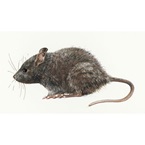
Black rat
Black Rat or Roof rat (Rattus rattus)
The black rat (Rattus rattus), also known as the roof rat or ship rat, is a common rodent pest found in urban, rural and coastal environments. Highly agile and an excellent climber, the black rat can cause damage to buildings, contaminate food sources and pose health risks through the transmission of diseases. Understanding its identification, behaviour and habitat is essential for effective pest management.
Rodentia
Rattus rattus
Muridae

Characteristics
Adults typically measure 180–230 mm, with a tail ranging from 180–240 mm.
They weigh 120–300 g.
Droppings are approximately 12 mm long and taper to a point.
Despite its name, the black rat is usually black to light brown in color.
Behavior
Black rats are native to India and East Africa. They were introduced to Europe more than 2,000 years ago and can now be found worldwide.
They are often found outdoors and tend to live in fields and agricultural land. They may also move into buildings and structures when food resources are limited.
A black rat's incisors grow very quickly, reaching almost 10 cm per year. To control this growth, they gnaw continuously, which can result in significant damage.
They urinate and produce droppings frequently, contaminating anything they come into contact with.
Risks
Black rats carry more than 45 different diseases and contaminate water, food, and the environment.
They cause food losses in crops, throughout the food supply chain, and in stored food production.
Adults typically measure 180–230 mm, with a tail ranging from 180–240 mm.
They weigh 120–300 g.
Droppings are approximately 12 mm long and taper to a point.
Despite its name, the black rat is usually black to light brown in color.
Behavior
Black rats are native to India and East Africa. They were introduced to Europe more than 2,000 years ago and can now be found worldwide.
They are often found outdoors and tend to live in fields and agricultural land. They may also move into buildings and structures when food resources are limited.
A black rat's incisors grow very quickly, reaching almost 10 cm per year. To control this growth, they gnaw continuously, which can result in significant damage.
They urinate and produce droppings frequently, contaminating anything they come into contact with.
Risks
Black rats carry more than 45 different diseases and contaminate water, food, and the environment.
They cause food losses in crops, throughout the food supply chain, and in stored food production.