
Expert Advice: How To Use Mode of Action to Guide Rodenticide Choice
Understanding how a rodenticide works is key to solving rodent infestations. From overcoming bait shyness to developing strategies for challenging environments, an active ingredient’s mode of action determines how a rodenticide performs. By matching the right mechanism and formulation to the problem, pest control officers (PCOs) can make more informed choices, improve results, and provide more reliable, long-lasting control strategies.

In this blog we speak to Envu expert Richard Faulkner (RF), National Account and Technical Manager UK & Ireland, and explore some of the most frequently asked questions about rodenticide modes of action.
Q: What is a mode of action?
RF: The mode of action (MoA) of a rodenticide is the way in which the active ingredient (AI) kills the target rodent.
Q: What are the different rodenticide modes of action, and how do they affect rodenticide functionality?
RF: There are currently three different modes of action in rodenticides, and our Envu toolkit uses two of these – anticoagulants and Cholecalciferol.
Anticoagulants work by inhibiting the enzyme Vitamin K1 epoxide reductase which disrupts the blood clotting mechanism. When a sufficiently high dose is consumed, death is caused by internal bleeding and fatal haemorrhage.
In Racumin® this MoA comes from the anticoagulant Coumatetralyl, and for the Rodilon® range the AI is Difethialone.
Anticoagulants are available in single and multi-feed formulations, giving PCOs different options for a wide range of situations.
The MoA for Harmonix® Rodent Paste is hypercalcification caused by the active ingredient Cholecalciferol. Once the target rodent takes a lethal dose its body goes into hypercalcemia, causing widespread calcification of the soft tissues, resulting in rapid kidney failure.
As a non-anticoagulant Harmonix® Rodent Paste is particularly useful for treating infestations where anticoagulant resistance is suspected.
Q: Customers often expect instant control. How can PCOs explain the delayed mode of action of first generation/multi-feed anticoagulants and how this can be beneficial?
RF: At the moment we’ve only got one first-generation AI on the market in the UK, and then there’s Coumatetralyl in most of Europe.
So if we look at the MoA of an anticoagulant, it basically stops the blood clotting process. With a single feed, if rats eat enough, they get a lethal dose straight away as the MoA inhibits the enzyme Vitamin K1 epoxide reductase. What you find though is that because there’s already that process going on in the blood before the rats had the lethal dose, the rodents will have to use up the body’s stores of the enzyme first, which is why death can take a number of days after a lethal dose is consumed.
The MoA will stop the blood clotting and then through their everyday mechanical processes – pushing through holes, leaping about etc – it will start to work. Every time any animal hits against something, tiny blood vessels will be broken. When the blood clots effectively, natural healing happens and the animal won’t notice it; but, once a fatal dose of anticoagulant is consumed, this repair will not happen and the rodent will basically die of internal bleeding.
In multi-feed anticoagulants the MoA is exactly the same, it just takes several feeds for the rodent to consume a lethal dose.
Rats are really intelligent, and the dominant rat in the colony will always feed first. With a quick acting, single-feed bait, the dominant rat will die shortly after consuming the bait, and the others in the colony will then naturally associate the bait with death and avoid it. That’s when we can get bait avoidance and bait shyness. It’s why you don’t always want a rodenticide that acts really quickly.
The other thing that can happen is that if a rat starts eating, but does not consume enough for a lethal dose, they start to feel ill, and then stop eating. Rats that have a sub-lethal dose will then totally avoid that food source (bait), and also that feeding area too.
The fact is there is no quick result – it’s unrealistic to think eradication of rats can happen in 24 hours. So a logical, well thought-out strategy is needed, that recognises rats’ nature to feed from trusted food sources, and remembering they generally exhibit neophobia. Rats don’t like new things in their environment; they will always have to habituate to something first.
So in order to conduct a rodent control program properly, PCOs have to habituate the rodent to the bait. They will also need to do all the required environmental management following an Integrated Pest Management (IPM) approach – eliminating food and water sources wherever possible, removing cover, and carrying out practical things like proofing first, making the environment as hostile to rodents as they can.
Q: When rapid control of a heavy infestation is needed, how does mode of action influence the speed of control and product choice?
RF: With a heavy infestation PCOs would probably either use a single-feed anticoagulant, or a Cholecalciferol product. What will influence the choice is the AI and asking questions like - is there known resistance in the area?
If a PCO thinks there’s resistance, then they are most likely to choose a single feed anticoagulant because they are more acutely toxic; or a Cholecalciferol product because there is no known resistance to this as it’s a naturally occurring substance. In the case of Cholecalciferol (vitamin D3), the MoA gives the rat an overdose.
Q: How can different mode of actions help with control strategies in sensitive environments?
RF: If there’s an area where there’s a high risk of secondary poisoning. For example, a lot of birds of prey or mustelids, predatory mammals e.g. stoats, weasels, otters, pine martins etc – then Cholecalciferol is a really good option as it doesn’t bioaccumulate - build up in the rodent’s body.
Anticoagulants on the other hand are bioaccumulative – they build up in the tissue of the animal and then if that animal is consumed by a predator, then there is secondary transfer.
For internal environments there’s less risk from secondary poisoning. From a non-target point of view, PCOs will then need to consider children and animals in the domestic situation.
It all comes down to doing a proper environmental risk assessment (ERA) first, and adhering to the specifications given in the audits for any given site.
Q: In urban or food-rich environments, how can mode of action and formulation quality help ensure control across entire colonies?
RF: When rats have an established and trusted food source it will take time for them to habituate to any bait because you’re introducing something new to their environment.
In an ideal scenario it’s always best to remove or contain competing food sources first, and make sure cleaning and housekeeping means there’s no rubbish or scraps of food left for rats to feed on. Even if alternative food can’t be completely eliminated, reducing it will have an effect as rats will then look for new sources to supplement their diet. This is where using a non-toxic monitoring paste to habituate rats first is a great tool. Once rats are feeding on the monitoring paste, PCOs can make the switch to the sister bait product knowing that rats will then feed on it. In addition, there’s less impact on the environment as toxic bait is specifically targeted and not being put down when it’s not needed.
Q: Can mode of action help overcome bait shyness?
RF: Rats are highly intelligent animals. If they associate a food source with death or pain they won’t eat it.
When a rodenticide with a slower acting MoA becomes accepted, there’s less chance of the rats associating the bait with pain or death, and a greater chance of more rats in the colony consuming the bait.
With multi-feed anticoagulants it takes several feeds to reach a lethal dose which can take 3-4 days of feeding. As there’s no immediate negative effect from consumption of the bait, it becomes a trusted food source, and rats in the colony will continue to feed on it, helping to overcome bait shyness.
With single-feed anticoagulants, if a rat eats a sub-lethal dose they and other rats in the colony will then associate the bait with danger and stop eating it altogether. So faster acting isn’t always better in the case of bait shyness.
Remember rats have to use up their stores of Vitamin K1 epoxide reductase before the anticoagulant MoA can start to take hold, which can take around 48 hours, so there’s a period of time between the rat eating any anticoagulant bait, and starting to display symptoms. Multi-feed anticoagulant baits give a longer window with no obvious ill effects, meaning less bait shyness and the opportunity for more rats in the colony to consume the bait.
Even though Cholecalciferol (Harmonix® Rodent Paste) is not an anticoagulant rodenticide and works with a different MoA, consuming a lethal dose will trigger the ‘stop feeding effect’ and the rodent will cease eating. So using the sister product Harmonix® Monitoring Paste first, to habituate rats to the formulation, will help PCOs address the problem of bait shyness in this case.
Q: When infestations are in hard to reach areas e.g. wall voids – how can using a rodenticide with an innovative mode of action help?
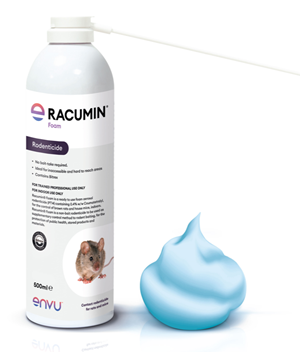
RF: Generally, if you’ve got access into an area you can usually put bait down safely, but Racumin® Foam is a great option for wall voids and cavities. The foam is very user-friendly and obviously PCOs are then not relying on the attractiveness of a bait, as the foam delivers the AI on contact as the rodent brushes past it, and the MoA takes effect once ingested via the rodents natural grooming behaviour.
In all areas, especially those that are inaccessible, the first step should always be to look at ways to keep the rodents out. Any hole over 5mm is accessible for rats and anything from the size of a pen is accessible to mice. Effective proofing can often help solve problems, without the need for rodenticides.
Q: How do formulation and mode of action determine whether a rodenticide will be effective for burrow baiting?
RF: Suitability for burrow baiting is always determined by what’s on the label of the product. The label will always explain what rodents can be treated, where the product has permitted use, and give all the information needed on dosing and application methods.
Q: How does the mode of action of first-generation multi-feed anticoagulants, like Racumin®, support cost-effective rodent control?
RF: Racumin® Foam is the only contact product that has rats on the label in the UK and Ireland. It becomes very cost effective in an area where PCOs are not getting bait take, and they can’t get the population under control with baiting or traps.
Using Racumin® Foam can save wasted bait and extra visits, giving control over neophobic rats with an alternative delivery mechanism that can be delivered through multiple entry and exit points.
Racumin® Expert delivers the MoA of Coumatetralyl in a bait formulation. The product is a first generation anticoagulant that gives reliable control with an AI at just 27 parts per million. The permitted usage also means it’s an effective option for open areas and waste dumps.
When using traditional bait products, monitoring first with a non-toxic product can also save on the cost and quantity of bait needed. By monitoring first, PCOs can ensure bait is only placed in areas where rats are active, knowing that they are already habituated and are feeding well from the bait source.
As ever, the decision of which rodenticide to use should always be based on the ERA for each site.
Q: Where baits have failed and resistance is suspected – can switching to a different mode of action help achieve cost effective control?
RF: Yes. Here PCOs would either choose a product with no known resistance like Rodilon®, or an alternative MoA like Cholecalciferol in Harmonix® Rodent Paste.
What makes Rodilon® stand out is that it’s got a higher LD 50, so under the COSHH assessment it would be the first choice over other single-feed anticoagulants. It gives reliable control with a very low level of the AI Difethialone – just 0.0025%.
Alternatively, using a completely different MoA is an option. Cholecalciferol (vitamin D3) in Harmonix® Rodent Paste doesn’t have the resistance issues associated with anticoagulants.
Q: How does product innovation of newer non-anticoagulant rodenticides help broaden the options available to PCOs?
RF: For PCOs getting Cholecalciferol back in the toolkit has been a game-changer.
Cholecalciferol gives an alternative MoA through Harmonix® Rodent Paste. Vitamin D3 naturally occurs in the body, but in a rodenticide an overdose of this substance is effectively delivered, pulling calcium from bone tissues into the blood. This MoA leads to calcification of soft tissues, organ failure, and death.
As it’s not an anticoagulant, there are no resistance issues associated with the Harmonix® AI; and as it’s heavily metabolised in rodents’ bodies, there’s little risk of secondary poisoning.